Atlanta is one of 16 host cities for the FIFA World Cup 2026, with eight matches scheduled at Mercedes-Benz Stadium across June and July. The tournament brings the largest single concentration of international corporate hospitality, sponsor activation, and inbound delegation traffic the city has ever experienced — larger than the 1996 Olympics by every operational measure that matters for ground transportation. Sponsor groups, FIFA partner organizations, suite-holders, corporate hospitality teams, and high-profile international guests all need executive ground transportation pre-positioned for match days, and the capacity question is structural — not commercial.
This guide is for the corporate hospitality teams, sponsor delegation managers, and event production coordinators running ground for FIFA 2026 Atlanta matches. It walks through match-day logistics, the post-match surge problem, vehicle selection by group size, and the advance-booking timeline that separates the groups who get the right capacity from the groups who do not.
For the headline operational summary, see our FIFA World Cup 2026 transportation page. This piece is the deeper reference for the planners coordinating the work.
What Atlanta Is Hosting
Mercedes-Benz Stadium hosts eight FIFA World Cup 2026 matches across the group stage and round of 16. The matches are spread across June and July, with several falling on weekend days and several on weekday evenings. Each match draws 70,000+ ticketed attendees plus an additional 10,000–20,000 in the immediate stadium district for sponsor activations, fan zones, and broadcast hospitality.
For ground transportation purposes, every match day in Atlanta functions like a multi-Super Bowl day. The corporate hospitality footprint runs from 8 AM (sponsor briefings, broadcast setup, hospitality pre-positioning) through 12 AM or later (post-match VIP departures, suite-holder dispersal, sponsor wrap-up). Multiply that by 8 match days, with the surrounding weekday traffic compressed because of the international visitor surge across the metro, and the operational ground transportation picture comes into focus.
The volume problem is not the match-day demand alone. It is the compression — eight match days plus four weeks of pre-tournament activation and post-tournament wrap-up — across a vehicle supply that is structurally fixed. Atlanta does not import 200 incremental Escalade ESVs for FIFA. The capacity that is on the ground in June 2026 is the capacity that was on the ground in May 2026. Groups that secure that capacity in advance get it; groups that do not are competing for whatever marginal supply exists after the major operators are booked out.
The Match-Day Timeline
Here is what match day actually looks like for a sponsor hospitality group.
6:00–10:00 AM: sponsor team and hospitality staff pre-positioning. Briefings, vendor coordination, activation site setup. Ground transportation at this phase is staff-and-equipment focused — branded vehicles, supply transport, key personnel pickups from hotels and FBOs.
10:00 AM–2:00 PM: delegation arrivals to Atlanta. For matches with significant international delegation, this is the airport surge — ATL international terminal, PDK Signature for principal arrivals via private aviation, hotel transfers from arrival to hospitality block. For an evening match, this window is the heaviest single block for chauffeured executive SUV demand.
2:00–5:00 PM: hospitality pre-event movements. Sponsor lunches at hotels, broadcast interviews, suite-holder activations at the stadium. Ground transportation routes between hotels, stadium hospitality entries, and offsite activation sites.
5:00–7:30 PM (for a 7:00 PM kickoff): the principal transport window. Delegation principals, VIP guests, sponsor executives, suite-holders all move to the stadium. This is the dense window — 60–90 minutes of high-frequency arrivals at the stadium's restricted-access vehicle zones. Ground transportation routes through credentialed-vehicle entries to drop directly at suite or VIP entrances.
7:00–9:30 PM (during the match): ground transportation idles or stages at pre-arranged off-stadium positions. Some groups release the chauffeur for the match window and re-book pickup; most retain the vehicle for post-match readiness.
9:30–11:30 PM (post-match): the surge. 70,000 attendees exit the stadium across 60 minutes. Sponsor hospitality wraps. Suite-holders descend. The credentialed-vehicle zones run at full capacity and stay congested for 45–90 minutes. Groups with pre-staged vehicles and pre-communicated pickup positions exit smoothly. Groups without are pulling rideshare apps in heavy surge waiting for a marginal driver to accept the trip.
11:30 PM–1:00 AM: dispersal. Hotel returns, late-evening hospitality continuation, departures back to private aviation FBOs for principals who fly out same-night. Ground transportation runs the post-match dispersal window at the same density as the pre-match window, just spread over 90 minutes instead of compressed to 30.
For a sponsor group with 30–50 hospitality guests, the day involves 12–18 hours of coordinated ground transportation across multiple vehicles. The dispatch coordination is the operational backbone of the day. The vehicles are the tools.
Vehicle Selection by Group Profile
The right vehicle for a FIFA 2026 hospitality movement depends on the group profile.
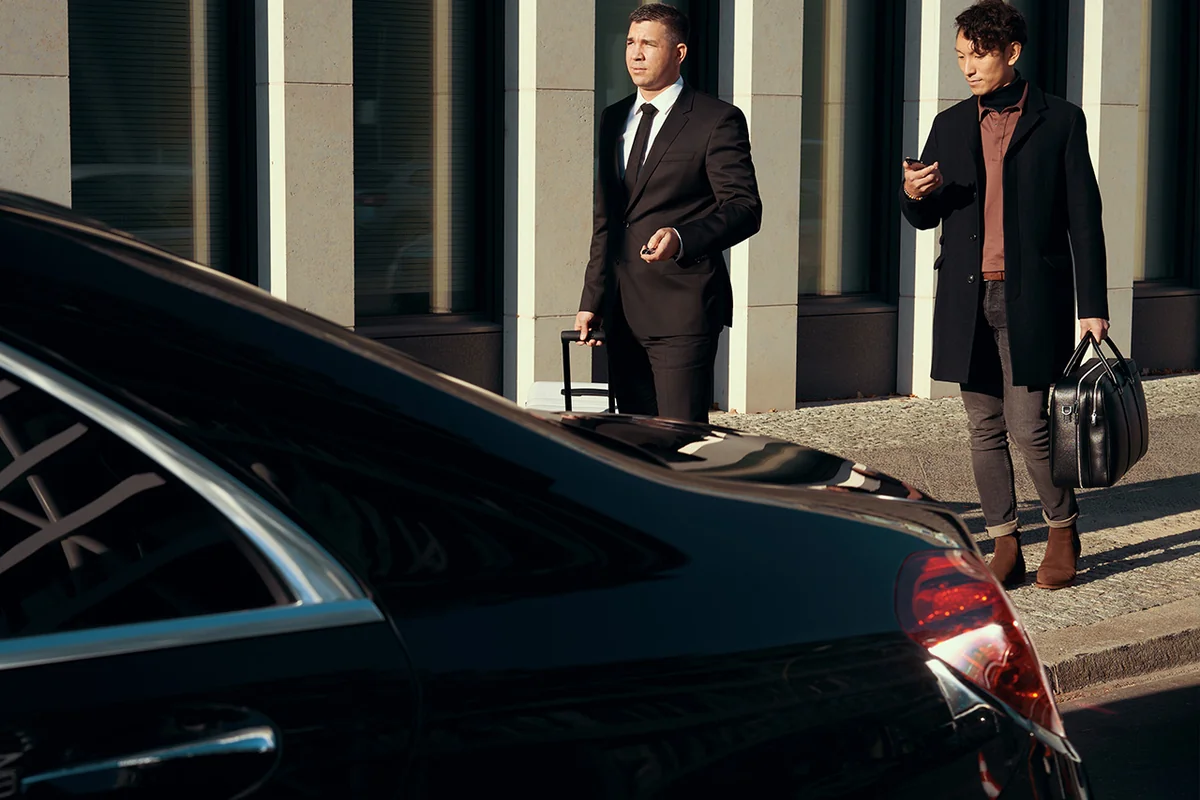
Principal arrival (1–3 passengers from FBO or hotel): executive sedan in Atlanta for the discrete arrival, or the Escalade ESV for the high-impact one. For the sponsor's principal guest, the Escalade ESV signals operational gravity. For the FIFA partner executive arriving discretely, the S-Class is correct.
Small VIP group (4–6 passengers): Cadillac Escalade ESV chauffeur in Atlanta is the default. Six adults, modest luggage, suite-holder arrival at the stadium. Alternatively the Range Rover chauffeur in Atlanta for groups wanting a different signaling profile, or the GMC Yukon XL chauffeur in Atlanta for full-size room with a more understated presence.
Hospitality core group (7 passengers): Mercedes V-Class chauffeur in Atlanta is the structurally correct vehicle for seven hospitality guests moving as one group. Captain's chair configuration, executive cabin, the V-Class signals European-tournament-hospitality in a way Atlanta SUVs do not.
Sponsor delegation (8–12 passengers): Mercedes Sprinter Van chauffeur in Atlanta for the full delegation moving together. Club configuration for sponsor entertainment with on-board hospitality elements. Executive cabin layout for delegation comfort.
Multi-vehicle hospitality fleet: for sponsor groups managing 20+ guests across multiple destinations, multi-vehicle dispatch with consistent fleet — three Escalade ESVs plus a Sprinter, or two Sprinters plus matched Escalade lead vehicle — signals coordinated operational gravity. Mixed fleet dispatch from a chauffeur company that cannot deliver consistent vehicle presentation diminishes the hospitality signal.
Principal arrival with elevated discretion (athletes, public figures, FIFA partner principals on confidential agendas): the Maybach chauffeur in Atlanta for the elevated discretion arrival vehicle. The Maybach is the option above the Escalade ESV when the trip is about elevated trim and quiet arrival.
The general rule for FIFA hospitality is to default one tier above what the same group would book on a non-tournament trip. The signaling matters. Visiting international principals coming to Atlanta for the World Cup expect the host operation to recognize the stature of the event. The vehicle is part of that recognition.
The Post-Match Surge Problem
The single largest operational risk for FIFA 2026 hospitality groups is the post-match transport surge. Here is the structural problem.
70,000 attendees exit Mercedes-Benz Stadium across roughly 60 minutes. Rideshare platforms go into heavy surge within 10 minutes of the final whistle. The stadium's credentialed vehicle zones operate at full capacity for 45–90 minutes — pre-arranged chauffeured pickups continue smoothly through this window; commercial rideshare pickups face 25–40 minute wait times for ride matching plus the surge multiplier.
For a sponsor hospitality group, the surge problem is not financial — it is operational. The principal guest of a sponsor activation does not wait 30 minutes for a surging rideshare after the final whistle. The host operation that allows that to happen has failed the hospitality engagement. The structural answer is pre-arranged chauffeur pickup with surge-proof flat-rate pricing and pre-positioned vehicle staging.
The post-match window operationally requires:
Pre-staged chauffeur position 4–6 blocks from stadium. Chauffeur is on-route or staged in the dispatch position 5–10 minutes before projected final whistle. Post-match congestion is avoided by exiting the immediate stadium district before the wave hits.
Pre-communicated pickup location to the guest. Principal or VIP guest knows in advance where the vehicle will be. SMS or pre-printed card communicates the location. No "find the car" friction at 10 PM.
Routing optimization for post-match exit. Chauffeur routes home or to next destination via the optimal post-match exit path — typically avoiding I-75/85 northbound at the final whistle in favor of side-street routing to Buckhead or Midtown destinations.
Capacity guarantee. The vehicle is held against the booking. There is no marginal-driver supply collapse because there is no marginal-driver model — the chauffeur is on payroll and on the dispatch for the night.
Groups that book ground transportation through a flat-rate chauffeur model with W-2 chauffeurs and pre-staged vehicles get the post-match window clean. Groups that rely on rideshare apps or marginal-supply broker networks do not.
When Should You Start Booking?
The advance-booking timeline for FIFA 2026 Atlanta hospitality ground transportation is the single most important operational decision the planner makes. The structural realities:
6+ months out (December 2025–February 2026): capacity reservation. Major Atlanta chauffeur operators close their FIFA 2026 capacity reservation books in this window. Sponsor groups, FIFA partner organizations, and high-volume hospitality producers lock fleet capacity at this stage. Pricing is at the contracted rate; capacity is guaranteed.
3–6 months out (March–April 2026): account-tier capacity. Recurring corporate accounts and known hospitality producers can secure fleet capacity at this stage with operator advance notice. New accounts can open and reserve, with structured pricing locked.
1–3 months out (April–May 2026): marginal capacity. Operators have committed inventory by this point. Last-minute requests compete for the remaining marginal capacity. Pricing is open-market rather than contracted; capacity is not guaranteed for specific vehicle types.
Under 30 days out: capacity gaps. Major operators are sold-out on premium fleet for match days. Available capacity is limited, mixed-fleet, with elevated pricing. For sponsor groups, this is the window where the hospitality signal becomes hard to maintain because the fleet is not consistent.
Under 7 days out: rideshare alternatives or out-of-market import. By this window, structural capacity is gone. Some operators import out-of-market drivers or import broker-network capacity, which produces inconsistent presentation. Sponsor hospitality groups should not be in this window.
For a sponsor hospitality team planning FIFA 2026 Atlanta, the operational answer is to open the conversation with the chauffeur operator in the 6+ month window and lock the reservation at the contracted rate. This is not a marketing recommendation — it is the structural answer to a fixed-supply demand problem.
Multi-Day Hospitality Coordination
Most FIFA 2026 sponsor activations are not single-day events. Sponsor groups typically run 3–7 days of hospitality programming around a match — arrival day, pre-match activation day, match day, post-match wrap-up day, departure day. Ground transportation for the full activation runs across multiple days, multiple destinations, multiple principal arrivals from FBO, and multiple suite-holder movements.
The right operational model for a multi-day FIFA activation is dedicated fleet assignment for the duration. Three Escalade ESVs plus a Sprinter assigned to the account for the full 5 days, with the same chauffeurs running the rotation. The chauffeurs learn the principal roster, the hospitality flow, the preferred pickup positions at each hotel and venue. By day 3, the operation is running on autopilot — by day 5, the chauffeurs anticipate the moves before the dispatch radio activates.
Hospitality coordinators who try to dispatch ground per-trip across a 5-day activation lose the operational continuity. Dedicated fleet assignment is structurally correct. For sponsor activations of significant scale, this is the only model that scales.
What's the Difference Between Match-Day Booking and Tournament-Wide Booking?
Two distinct booking patterns are common for FIFA 2026 Atlanta.
Match-day booking is single-event focused — one match, one hospitality program, one group of 10–30 guests, one day of ground transportation. The booking is sized to the match day, the surrounding activation, and the dispersal. Vehicle assignment is fixed for the day; chauffeur consistency is for the day. Tournament-wide capacity is not held against the account.
Tournament-wide booking is multi-match focused — the sponsor group attends multiple Atlanta matches across the tournament, the host firm hosts recurring delegations, the FIFA partner organization runs activation across the full tournament window. The booking reserves fleet capacity across multiple match days and the surrounding activation windows. Pricing is locked tournament-wide; chauffeur consistency is across the tournament.
For sponsor groups attending one match, match-day booking is correct. For FIFA partner organizations, multi-match sponsor groups, or hospitality producers running activations across multiple matches, tournament-wide booking is structurally correct and is the only model that secures the fleet consistency across the tournament.
Booking FIFA 2026 Atlanta Ground Transportation
Three ways:
- Phone — dispatch at (770) 310-8765 for FIFA 2026 capacity inquiries.
- Email — info@chauffeurslane.com for sponsor group, FIFA partner, or hospitality producer inquiries.
- Account onboarding — apply through corporate accounts for tournament-wide capacity reservation.
For dedicated FIFA coverage, see our FIFA World Cup 2026 Atlanta page. For vehicle detail, see executive SUV Atlanta, Mercedes V-Class chauffeur Atlanta, and Sprinter Van chauffeur Atlanta.
Final thought: FIFA 2026 Atlanta is a structurally fixed-supply window. The hospitality groups that lock capacity 6+ months out get the right fleet, the right chauffeurs, the right operational consistency. The groups that wait do not. The booking decision is happening now.
Call (770) 310-8765 or email info@chauffeurslane.com to open the FIFA 2026 conversation.
Ready when you are
Book a chauffeur — or talk to dispatch.
Reserve online in a few clicks, or speak with someone who knows the Atlanta roads as well as the calendar.